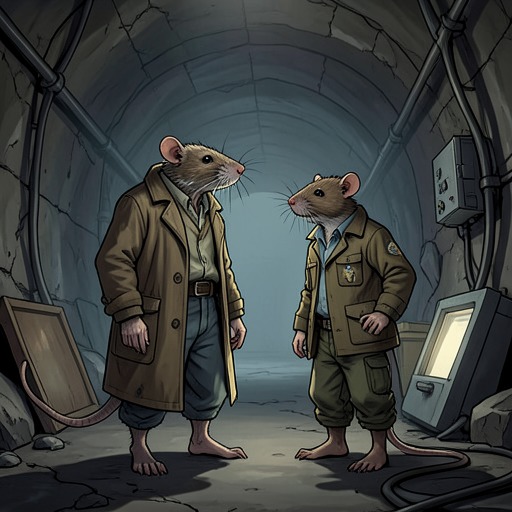
Dangerous Beans—Hamnpork
The Amazing Maurice and His Educated RodentsDangerous Beans—Hamnpork is a relationship shaped by the upheaval of the Change: a contest between an old model of rat leadership, grounded in force and instinct, and a new ethical imagination. Hamnpork doubts the direction Dangerous Beans proposes, but cannot simply dismiss him. The tension is consequential precisely because respect and resistance coexist: the Clan needs to decide what its new capacity to think means, and its leader is being asked to follow an answer he does not always understand.
Identity and Background
Hamnpork is the Clan’s leader, accustomed to a world in which a rat leader needed chiefly to be large and forceful. Since the Change, however, events have moved faster than he can comfortably follow. He dislikes Maurice and much of what has happened, and senses that his position has shifted: he is no longer simply leading but being pushed along by circumstances and by ideas that have altered what rats can do. His frustration is not just personal irritation; it marks the strain on a kind of authority built for a simpler world.
Dangerous Beans offers a contrasting kind of influence. He is nearly blind, physically weak, and neither large nor fast, but his questions make him important to rats stronger than himself. Peaches speaks on his behalf when Hamnpork might not listen to her directly, because Dangerous Beans is the closest thing the rats have to a wizard and even the big rats listen to him. Their relationship therefore begins within a shift in power: Hamnpork retains the leadership role, while Dangerous Beans gains authority through thought and the ability to give unfamiliar experiences meaning.
Competing Ideas of Rat Nature
Their deepest disagreement concerns whether the Change merely gives rats new abilities or also places new obligations on them. Hamnpork’s account of rat nature is practical and closed: rats run, hide, eat, and reproduce. When Dangerous Beans asks what a rat is, Hamnpork answers in terms of teeth, claws, tail, and survival. His response treats inherited behavior as a complete definition, leaving little room for a rat to choose what it should become.
Dangerous Beans refuses that boundary. The very ability to ask what a rat is, he argues, means that rats are more than their familiar instincts. His questions also unsettle the explanation that rats were simply made to behave as they do: when Hamnpork invokes the Big Rat theory, Dangerous Beans asks who made the Big Rat. The dispute is not settled by a clever retort. Rather, it exposes how quickly a practical description of animal life can become a claim that no other way of living is possible.
Hamnpork’s skepticism appears in ordinary decisions as well as arguments about identity. When Dangerous Beans proposes that the rats settle down, Hamnpork recalls his own preferred plan of finding an island by boat, which seems more recognizably rat-like to him. He is also uncomfortable with the need for money and with the word ethical, which he struggles to pronounce and regards as alien to rats. Dangerous Beans supplies the word without ridicule. The small exchange captures their difference: Hamnpork sees ethical conduct as a strange demand imposed by changed circumstances; Dangerous Beans treats it as part of what those circumstances now require.
Resistance, Reliance, and Leadership
Fire makes the contrast especially concrete. Hamnpork watches a candle flame suspiciously, objects that darkness was good enough for earlier generations, and regards burning a candle as wasting food. Dangerous Beans instead explains the flame as a way for the Clan to declare its separateness: the rats are not merely rats, but a community with a shared identity. Hamnpork responds with his familiar grunt, a sign that he has not understood. His reaction is skeptical, but it also shows that Dangerous Beans is asking him to interpret a new world rather than merely react to it.
The generational difference does not mean that Hamnpork wholly rejects the younger rat. Dangerous Beans’ ideas irritate him, yet Hamnpork follows him, as do Darktan and other senior rats. The thoughts spread through the Clan, including through the language and questions used by its members. Hamnpork’s leadership is thus placed in an unusual relation to Dangerous Beans: he remains the formal leader, but some of the direction the Clan takes comes from someone whose authority is intellectual and moral rather than physical.
That dependence can feel like a challenge even when Dangerous Beans does not intend one. When a newcomer’s presence provokes a dispute, Hamnpork bristles as Dangerous Beans argues that thinking rats can consider the consequences of their actions, pity someone innocent who means them no harm, and allow her to stay. Hamnpork instinctively turns toward the speaker, ready for confrontation, while Dangerous Beans remains unaware that his position has challenged the leader. Peaches recognizes the imbalance: Hamnpork is an experienced leader, and Dangerous Beans could not prevail in a physical fight, but his argument has nonetheless made the encounter a test of authority.
The Relationship’s Significance
The conflict does not reduce to a contest in which one rat simply defeats the other. Hamnpork’s resistance makes visible the cost of change for a leader whose old measures of strength no longer suffice; Dangerous Beans’ influence shows that newly acquired thought can create standards that instinct alone cannot provide. At the same time, Hamnpork’s willingness to follow and listen prevents the relationship from becoming a simple opposition between an obsolete ruler and a wholly separate reformer. The Clan’s transformation takes place through the friction between them, within a community that still needs both leadership and new ways to understand its choices.